

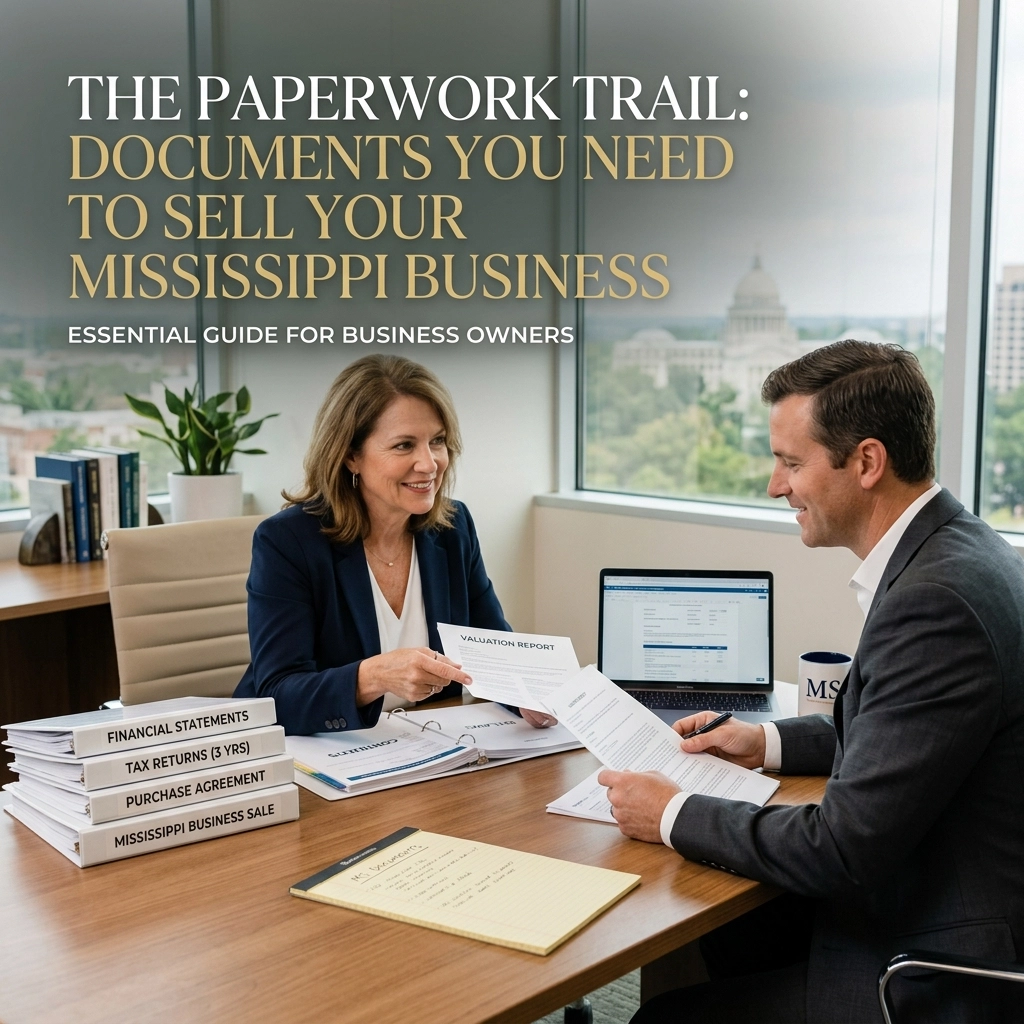
If you’re thinking about selling your Mississippi business, you need to understand that the deal isn’t made at the handshake: it’s built in your filing cabinets and on your hard drive. Most owners wait until they have a live buyer on the hook before they start digging through old boxes or calling their CPA. That is a massive mistake that kills deals and tanks valuations.
Buyers don't buy your potential; they buy your proof.
In the world of business brokerage, I see it happen again and again. An owner has a fantastic company with great cash flow, but when it comes time to verify that income, the trail goes cold. If you can’t prove it, it doesn’t exist in the eyes of a serious buyer or a bank. To get the best price for your business in Mississippi, you have to be ready before you even list.
Why the Paperwork Trail Matters for Your Valuation
Here’s the thing: a buyer is essentially buying a future stream of income. To feel confident in that future, they need to see a clear, documented past. When your paperwork is messy, it signals risk. High risk equals a lower purchase price or, worse, a buyer who walks away entirely during due diligence.
Preparation allows you to control the narrative. By having your documents organized and ready, you demonstrate that you run a professional operation. This builds trust immediately. It also speeds up the process. A deal that drags on for months because of missing tax returns or expired leases is a deal that is likely to fall apart.
The Financial Foundation: Proving the Profit
The first thing any qualified buyer will ask for is your financial history. They aren't just looking at the bottom line; they’re looking for trends, margins, and the "real" owner benefit.
Tax Returns (Last 3 Years): This is the gold standard. Buyers and lenders want to see federal tax returns that match what you’re claiming the business makes. If there is a massive discrepancy between your internal books and what you told the IRS, you have a problem.
Profit & Loss (P&L) Statements: You should have year-to-date P&L statements as well as annual statements for the last three years. These should be broken down monthly so a buyer can see the seasonality of your Mississippi business. Whether you're running a landscaping company in Jackson or a boutique in the Delta, seasonality matters.
Balance Sheets: This shows the health of your business at a specific point in time. It lists your assets, your liabilities, and your equity. A buyer needs to know exactly what they are stepping into regarding debt and asset value.
The "Add-Back" Schedule: This is where the magic happens. Many small business owners run personal expenses through the business to reduce tax liability. We call these "add-backs." You need to document these clearly: whether it’s a personal vehicle, health insurance, or one-time repairs: so we can calculate the true Seller’s Discretionary Earnings (SDE).
If you aren't sure what your business is actually worth based on these numbers, you should start with a valuation request.
The Legal Backbone: Contracts and Obligations
Once a buyer is satisfied with the money, they’ll look at the structure. They need to know that if they buy the business, they actually have the right to operate it and keep the customers.
Leases and Property Agreements: If you don't own the real estate, your lease is one of your most valuable assets. You need a copy of the current lease and any amendments. Specifically, you need to know if the lease is assignable to a new owner. If your landlord can kick a new owner out, your business is much harder to sell.
Articles of Incorporation / Operating Agreements: You must prove you have the legal authority to sell the entity. This includes your Mississippi Secretary of State filings and any internal agreements between partners.
Customer and Vendor Contracts: Do you have long-term contracts with your biggest clients? Are there written agreements with your suppliers? Buyers love recurring revenue and stability. If your business relies on "handshake deals," it’s time to get those in writing.

Operational Documents: How the Business Actually Runs
A buyer wants to know that if you walk away, the business won't collapse. This is often the difference between a "job" and a "business."
Standard Operating Procedures (SOPs): Do you have a manual that explains how things get done? From opening the doors to fulfilling orders, documented processes make your business much more attractive to an outside buyer who may not have your 20 years of experience.
Employee Records: You don't need to provide personal details early on, but a buyer will want to see an organizational chart, job descriptions, and compensation packages. They need to know who the key employees are and if they are likely to stay after the sale.
Equipment and Asset List: Every "tangible" thing included in the sale needs to be on a list. This includes VIN numbers for vehicles, serial numbers for machinery, and a general inventory of furniture and fixtures.
The Shield of Confidentiality
Here is a critical point: keep your mouth shut.
Selling a business is not like selling a house. You don't put a "For Sale" sign in the front yard. If your employees find out you're selling, they might start looking for new jobs. If your competitors find out, they will tell your customers that you’re "going out of business" to steal their loyalty.
Confidentiality is the most important part of the early stages. You should never hand over the documents listed above without a signed Non-Disclosure Agreement (NDA) and a summary of the buyer's financial capability. This is why many owners choose to work with an advisor who can vet buyers before they ever see the name of the company.
Working with an experienced firm like Biz Broker Mississippi ensures that your sensitive data is protected. We manage the flow of information so that only serious, qualified buyers get a look under the hood.

The Essential Document Checklist
To make this easy, here is the "Short List" of what you should start gathering right now:
- Financials:
- Federal Tax Returns (last 3 years)
- Year-to-Date P&L and Balance Sheet
- Current Accounts Receivable/Payable aging reports
- Legal:
- Current Lease Agreement and any extensions
- Business licenses and permits (local and state)
- Formation documents (LLC or Inc. papers)
- Operational:
- Detailed list of equipment, furniture, and fixtures
- List of key employees and their roles (no names needed initially)
- Marketing materials and a list of social media assets
Why Geography Doesn't Limit Your Sale
I see a lot of owners think they need to find a broker in their specific town. That’s simply not true. In fact, in many cases, working with a broker who is not in your immediate neighborhood is better for confidentiality.
Buyers for Mississippi businesses often come from across the state, from neighboring states like Louisiana or Alabama, or even from national investment groups. We work with owners across the entire region, from the Gulf Coast to the Tennessee line, because we have the reach to find the right buyer, not just the closest one.
Expertise in the Mississippi market trends and regional economic conditions is what matters. Whether your business is located in Jackson, the Pine Belt, or along the Coast, the process of documenting and defending your valuation remains the same.
Moving Forward
Gathering this paperwork is a chore. I get it. You're busy running the business that you're trying to sell. But look at it this way: every hour you spend organizing your documents now is worth thousands of dollars at the closing table.
When you have a "clean" trail of paperwork, you take away the buyer's leverage to negotiate the price down. You show them a healthy, transparent, and profitable company that is ready for a new owner to step in and succeed.
If you’re ready to see how your paperwork stacks up and what your business might be worth in the current market, we are here to help.
To learn more about our company, visit https://visionfox.com/.
Don't wait for the clock to decide your exit strategy. Get your paperwork in order today, and sell on your own terms.